
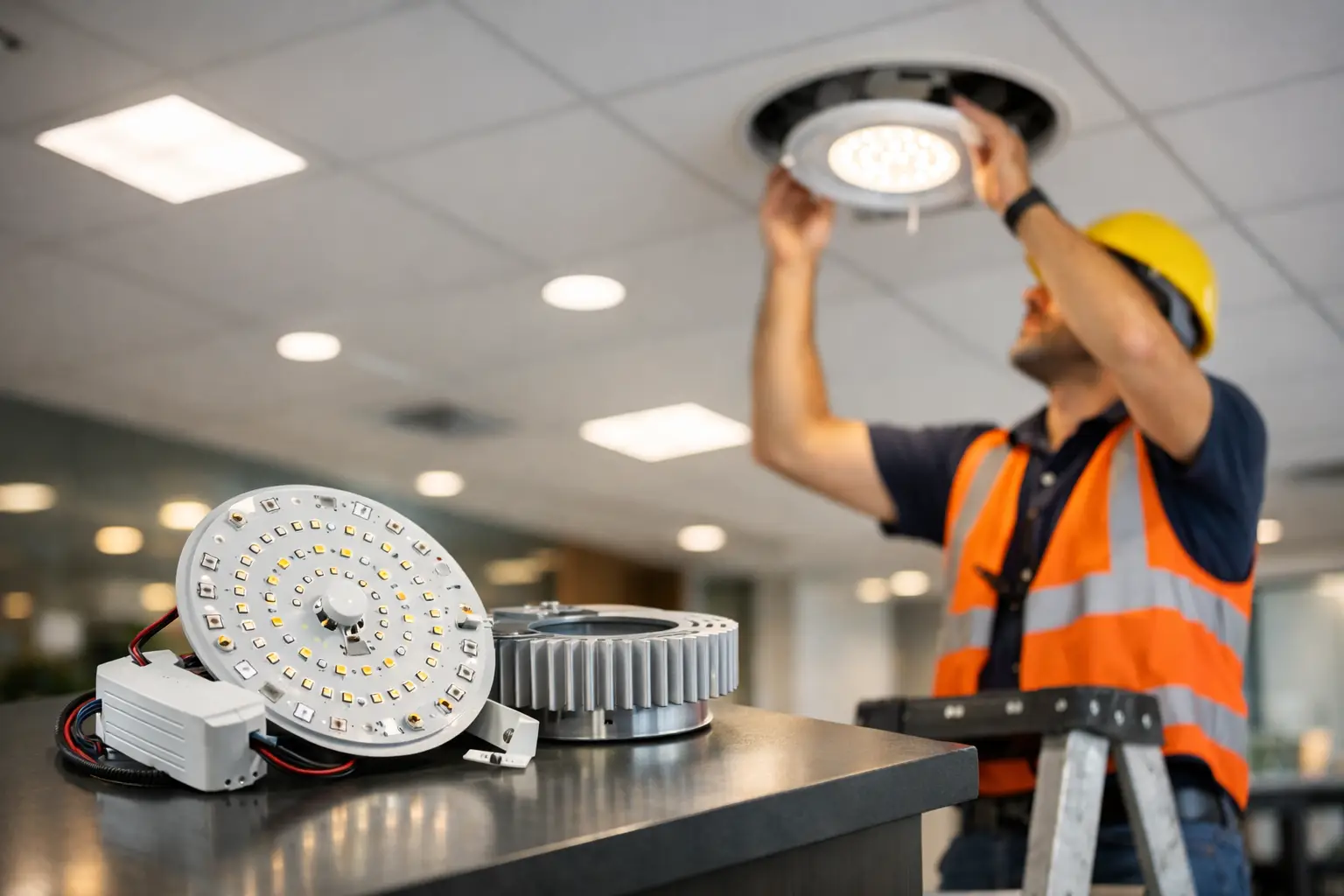
A fluorescent fixture can still look serviceable from the floor while quietly driving up operating costs above it. Lamps dim, ballasts fail, maintenance calls multiply, and lighting quality becomes inconsistent across the facility. Replacing every fixture may be appropriate in some projects, but it is not automatically the best financial or operational decision.
That is why choose LED retrofit kits is a question worth answering at the fixture level, not with a generic product comparison. A well-engineered retrofit preserves a sound existing housing while replacing the inefficient components inside it with a high-performance LED system. For commercial and industrial facilities, that approach can reduce energy use, simplify project execution, and produce a faster return without the disruption of a full fixture replacement.
Why Choose LED Retrofit Kits Instead of Full Replacement?
The strongest case for an LED retrofit begins with the condition of the existing fixture. Many recessed troffers, strip fixtures, and other fluorescent housings are structurally sound even when their lamps and ballasts are outdated. Removing those housings creates extra labor, ceiling work, disposal requirements, and potential interruptions to occupied spaces. A retrofit lets the facility keep the enclosure that already fits the space while modernizing what matters most: the light source, optics, electrical components, and controls compatibility.
The result is not simply a new lamp in an old fixture. A purpose-built retrofit kit can turn an aging fluorescent fixture into a high-efficacy LED luminaire while retaining the clean appearance and practical fit of the original installation. This is particularly valuable in offices, schools, healthcare support areas, warehouses, manufacturing facilities, and multi-site portfolios where the fixture layout is already functional.
Full fixture replacement still has a place. If housings are corroded, damaged, poorly located, or unable to meet the desired lighting distribution, a new luminaire may be the better choice. Retrofit is most compelling when the existing fixture body is in good condition and the project needs to control cost, installation time, and disruption.
Lower Energy Use Drives Long-Term Savings
Fluorescent lighting wastes energy in ways that are easy to overlook when viewed fixture by fixture. Across hundreds or thousands of fixtures, the combined draw of lamps and ballasts becomes a meaningful operating expense. LED retrofit kits reduce wattage while providing consistent, useful light where people work.
Efficiency should be evaluated at the fixture level, not just by the advertised output of an individual LED component. Fixture efficacy accounts for the light that actually leaves the completed fixture relative to the power it consumes. Higher fixture efficacy means more usable lumens for every watt purchased, which directly improves utility savings and can reduce the number of fixtures or wattage needed to achieve target light levels.
High-efficacy retrofit systems can exceed 190 lumens per watt at the fixture level. That performance changes the economics of an upgrade. Lower energy consumption reduces monthly utility costs, while better efficacy can also improve the project’s eligibility for utility incentives. In many markets, the most efficient products qualify for the strongest rebates, helping reduce the initial project cost and shorten payback.
Savings are not limited to the electric bill. LEDs also produce less waste heat than fluorescent systems. In cooled commercial spaces, that can modestly reduce cooling load, especially where lighting operates for long daily hours.
Installation Time Is a Project Cost
Labor often determines whether a lighting upgrade stays on budget. Traditional fixture replacement may require disconnecting and removing the old fixture, modifying the ceiling, installing new hardware, reconnecting branch wiring, and repairing the surrounding surface. Those steps take time and can be difficult to schedule in active facilities.
A well-designed retrofit kit addresses that cost directly. Optilumen’s tool-free magnetic retrofit approach was developed around a common field reality: contractors and maintenance teams need a dependable installation method that does not turn every fluorescent upgrade into a construction project. The magnetic components install into compatible existing fixtures without the drilling, fastening, and repeated handling that slow down conventional retrofit work.
When a kit can be installed in roughly three to four minutes, the effect extends beyond labor hours. Faster work means less time on ladders, fewer disruptions in occupied rooms, and a more manageable rollout across large facilities. In many applications, trained in-house maintenance personnel can complete the work rather than requiring a skilled electrician for every fixture. Electrical work should always follow applicable codes, site policies, and the retrofit manufacturer’s instructions, but reducing unnecessary installation complexity can substantially lower total project cost.
This matters in sensitive spaces. Healthcare facilities, schools, call centers, laboratories, and production environments cannot always tolerate extended closures or ceiling access. A short, repeatable retrofit process helps teams upgrade lighting around operating schedules instead of putting operations on hold.
Better Lighting Supports the Work Happening Below
Energy savings do not compensate for poor light quality. Facility managers and occupants notice flicker, glare, uneven illumination, and inconsistent color long before they see an energy report. The right retrofit kit should provide stable output, appropriate color temperature, and a clean distribution suited to the task and room geometry.
For office and education spaces, uniform ambient lighting and visual comfort are often priorities. Warehouses and industrial spaces may require higher light levels, dependable performance in long operating hours, and better visibility for safety-sensitive tasks. A retrofit should be selected around the application, not merely by choosing the lowest wattage available.
It also pays to evaluate the full fixture rather than assuming an LED tube will solve every fluorescent problem. Basic lamp replacements can be useful for limited budgets or temporary needs, but they may retain aging ballast components or deliver less controlled optics. A complete LED retrofit kit removes more of the legacy system and gives the project team a clearer path to predictable performance, efficiency, and long service life.
Fewer Maintenance Events Improve the Real Return
Fluorescent maintenance is rarely a single event. It is a recurring cycle of lamp changes, ballast failures, inventory management, lift access, labor, and disruption. In high-ceiling areas or facilities with round-the-clock operations, the maintenance burden can become more expensive than the replacement parts themselves.
Quality LED retrofit systems are designed for long service life, which reduces the frequency of those routine interventions. Fewer maintenance calls mean maintenance teams can focus on higher-value work, and facility occupants experience fewer interruptions. That is especially relevant for multi-site operators who need consistency in both lighting performance and replacement planning.
Not all LED products offer the same durability. Buyers should look beyond initial price and assess thermal management, driver quality, component serviceability, warranty terms, and the manufacturer’s ability to support the product after the sale. Commodity products may appear attractive at bid time but can create expensive failures, inconsistent color, or replacement challenges later.
How to Evaluate an LED Retrofit Kit
The right specification starts with a site review. Confirm the existing fixture types, housing condition, voltage, ceiling access, operating hours, and the required light levels for each area. Then compare retrofit options based on delivered fixture performance and project economics, not just a catalog wattage.
Ask practical questions: Does the system eliminate the ballast or depend on it? How quickly can a trained installer complete each fixture? Is the kit designed for the existing housing? What fixture efficacy is achieved? Does it qualify for available rebates? Can the manufacturer provide photometric, electrical, and warranty documentation needed for the project?
Contractors should also consider repeatability. A product that installs quickly once but creates exceptions across different fixture conditions can erode labor savings. Facility teams should consider future maintenance and whether the supplier can support a standardized product across locations. The best retrofit is one that works on paper, installs cleanly in the field, and continues delivering savings years after commissioning.
Retrofit Economics Depend on the Whole Project
The lowest purchase price is not always the lowest project cost. A less efficient kit may miss higher rebate tiers, consume more energy for its entire life, and require more installation time. Similarly, a high-performing kit may not be the right answer if the existing fixture housings are failing or if the facility needs a new lighting layout.
A sound financial comparison includes product cost, labor, rebates, avoided maintenance, annual operating hours, energy rates, and the expected life of the system. For many commercial and industrial upgrades, the combination of high efficacy, short installation time, and reduced maintenance produces a stronger return than either fluorescent lamp replacement or full fixture replacement.
The practical value of an LED retrofit is simple: it lets a facility improve a system that is still structurally useful without carrying forward the inefficiency and maintenance burden of fluorescent technology. When the existing housing is sound and the retrofit is engineered for fast, high-efficacy performance, the upgrade can improve the budget, the schedule, and the space at the same time.
Leave a Reply