
A failing ballast rarely quits at a convenient time. It starts with flickering, delayed starts, buzzing, or a dark section of a facility that keeps generating maintenance calls. If you are looking up how to replace ballast fixtures, the real question is usually bigger than swapping one bad component. It is whether that fixture should be repaired at all, or whether it makes more sense to move the space to LED and stop dealing with ballast failures altogether.
In commercial and industrial buildings, that decision affects labor, downtime, rebate value, and long-term operating cost. Replacing a ballast can restore a fluorescent fixture for now, but it also keeps an aging platform in service. In many cases, replacing the ballast fixture with an LED retrofit or a new LED luminaire is the better business move.
How to replace ballast fixtures: start with the right decision
The phrase “replace ballast fixtures” can mean a few different things in the field. Sometimes it means replacing the ballast inside an existing fluorescent fixture. Other times, it means removing fluorescent ballast-based fixtures and installing LED fixtures or LED retrofit kits in their place. Those are very different scopes of work, and the best path depends on fixture condition, labor cost, and how long you plan to keep the building.
If the housing is solid, the lens and door are in good shape, and the layout already works for the space, a retrofit usually makes sense. You keep the fixture body, remove the fluorescent components, and upgrade the performance. If the fixture is damaged, badly corroded, poorly distributed for the application, or difficult to maintain, full fixture replacement may be more practical.
This is also where labor changes the math. A simple ballast swap can look cheap on paper, but repeated service calls add up quickly. An LED retrofit typically costs more upfront, but it removes the ballast from the equation and cuts future maintenance substantially.
Safety comes first before any ballast fixture replacement
Before touching a fluorescent fixture, de-energize the circuit at the breaker and verify power is off with an appropriate tester. In commercial facilities, lockout/tagout procedures should be followed based on site policy and code requirements. This is not just a box to check. Ballasts can hold residual charge, and older fixtures may have brittle wiring, damaged tombstones, or components that have been overheated over time.
You also need to know the age of the fixture. Some older fluorescent ballasts may contain PCBs, particularly in units manufactured decades ago. If that is a possibility, handle removal and disposal according to applicable environmental and safety regulations. The same applies to fluorescent lamps, which contain mercury and should never be treated as standard trash.
For maintenance teams, the practical point is simple: if there is uncertainty about electrical condition, code compliance, or hazardous material handling, escalate the work to a qualified professional. Fast work only helps if it is safe work.
When replacing the ballast makes sense
There are still situations where replacing only the ballast is reasonable. If a facility plans a broader renovation later, a short-term repair may bridge the gap. The same is true if you have a small number of fixtures in a low-priority area and need the quickest possible restore. In those cases, matching the ballast to lamp type, lamp count, input voltage, and fixture configuration is critical.
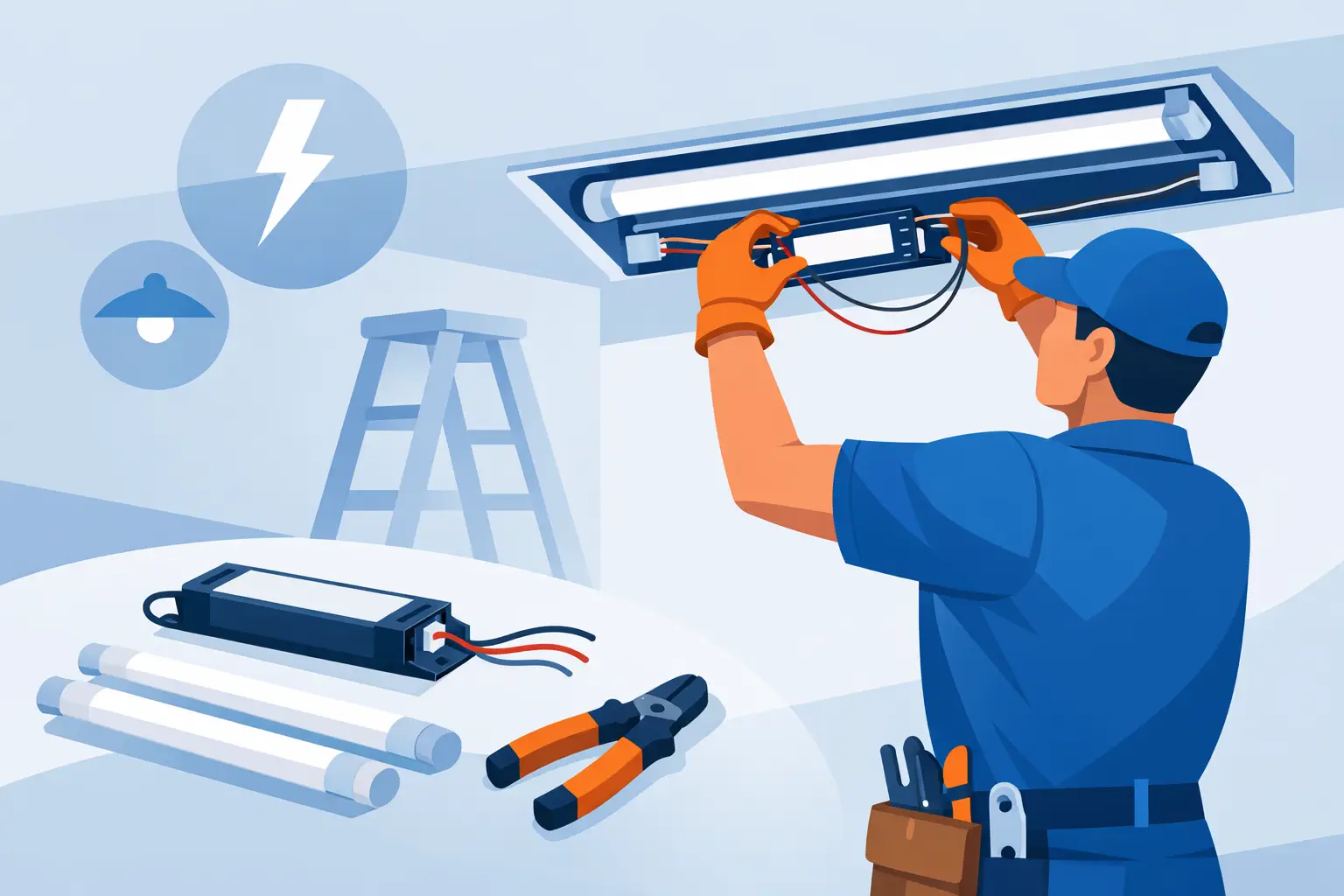
The process is straightforward in concept. Remove lamps, open the fixture, document the existing wiring, disconnect the old ballast, mount the new one, reconnect wiring per the ballast diagram, inspect sockets and conductors, reinstall lamps, and test operation. The problem is that the fixture is often older than the ballast chart makes it seem. Socket wear, insulation breakdown, and poor contact can leave you with another failure point even after the new ballast is installed.
That is why ballast replacement is often a repair, not a long-term upgrade. It gets the lights back on, but it does not modernize the system.
When to replace ballast fixtures with LED instead
If you are evaluating how to replace ballast fixtures across a warehouse, school, office, retail location, or industrial site, LED is usually the stronger long-range option. It reduces wattage, removes the ballast, improves light quality, and lowers maintenance frequency. For portfolio owners and facility managers, those benefits matter more than the cost of a single part.
There are two common paths. One is a full fixture replacement, where the entire fluorescent unit is removed and a new LED luminaire is installed. The other is a retrofit, where the existing housing stays in place and the lighting system inside is replaced with LED components.
Retrofit often wins where ceiling disruption, labor efficiency, and speed matter. In occupied commercial spaces, minimizing intrusion can be just as important as energy savings. A well-engineered retrofit can preserve the finished look of the space while delivering better performance and faster installation.
What the LED retrofit process typically looks like
In a typical fluorescent-to-LED retrofit, the lamps and ballast are removed first. The installer then prepares the fixture housing, installs the retrofit components, makes the required line-voltage connections, and secures the LED light engine or strips and driver according to the product design. The exact steps vary by kit, but the goal is the same: remove failure-prone fluorescent components and convert the fixture into a modern LED system.
This is where product design matters more than spec-sheet claims. Some retrofit products are field-friendly and fast to mount. Others are awkward, hardware-heavy, and time-consuming above the ceiling or on a lift. For contractors and maintenance teams, install time directly affects project cost and scheduling. A kit that saves even a few minutes per fixture can change labor totals significantly across a large job.
That is one reason many commercial buyers prefer retrofit systems designed around real installation conditions. Tool-free magnetic retrofit kits, for example, reduce handling time and help crews move quickly without sacrificing a secure fit. In high-volume projects, that speed can improve profitability while reducing disruption for the facility.
Key factors that affect the best replacement approach
The right answer depends on more than whether the ballast is bad. Fixture count matters. So does ceiling height, access, operating schedule, and the cost of shutting down the space. A single office fixture is one thing. A distribution center with hundreds of fixtures running long hours is another.
Utility rebates can also shift the economics. High-efficacy retrofit solutions often qualify for stronger incentives, which improves payback and makes replacing ballast-based systems easier to justify. Energy savings alone are valuable, but rebate structure and installation labor are often what decide whether a project gets approved this quarter or pushed out again.
Light performance should be part of the decision as well. Fluorescent systems that have aged unevenly can create inconsistent light levels and color appearance across the space. An LED upgrade gives you the opportunity to improve uniformity, visibility, and control options instead of simply restoring the old condition.
Common mistakes during ballast fixture replacement
One of the biggest mistakes is treating all fluorescent fixtures as equal. They are not. Fixture housing condition, branch circuit voltage, socket type, and mounting method all influence what replacement path will work cleanly.
Another common mistake is focusing only on material cost. A cheaper ballast or low-end retrofit product may save a little upfront, but if it adds installation time, creates compatibility issues, or fails early, the total project cost goes in the wrong direction. Commercial lighting decisions should be made on lifecycle value, not only on the invoice for the part.
There is also the issue of partial upgrades. Replacing a few failing ballasts in a space with many aging fixtures can keep maintenance problems alive for years. If the building has enough run hours and enough recurring service calls, it is usually smarter to evaluate the system as a group instead of one fixture at a time.
A practical way to move forward
If you are dealing with recurring fluorescent failures, start by separating short-term repair needs from long-term upgrade needs. For urgent restoration in a limited area, a ballast replacement may be appropriate. For larger spaces, repeated failures, or facilities with aggressive energy and maintenance targets, replacing ballast fixtures with an LED retrofit or new LED fixture usually delivers better results.
The most effective projects are the ones scoped with field reality in mind. That means looking at labor, access, downtime, rebate eligibility, fixture condition, and expected years of occupancy before choosing a path. Buyers who do that well are not just fixing lights. They are reducing service calls, improving operating margins, and making the building easier to manage.
For commercial and industrial facilities, that is the real value behind learning how to replace ballast fixtures. The job is not simply to restore illumination. It is to choose the replacement strategy that makes the next ten years easier than the last one.
Leave a Reply