
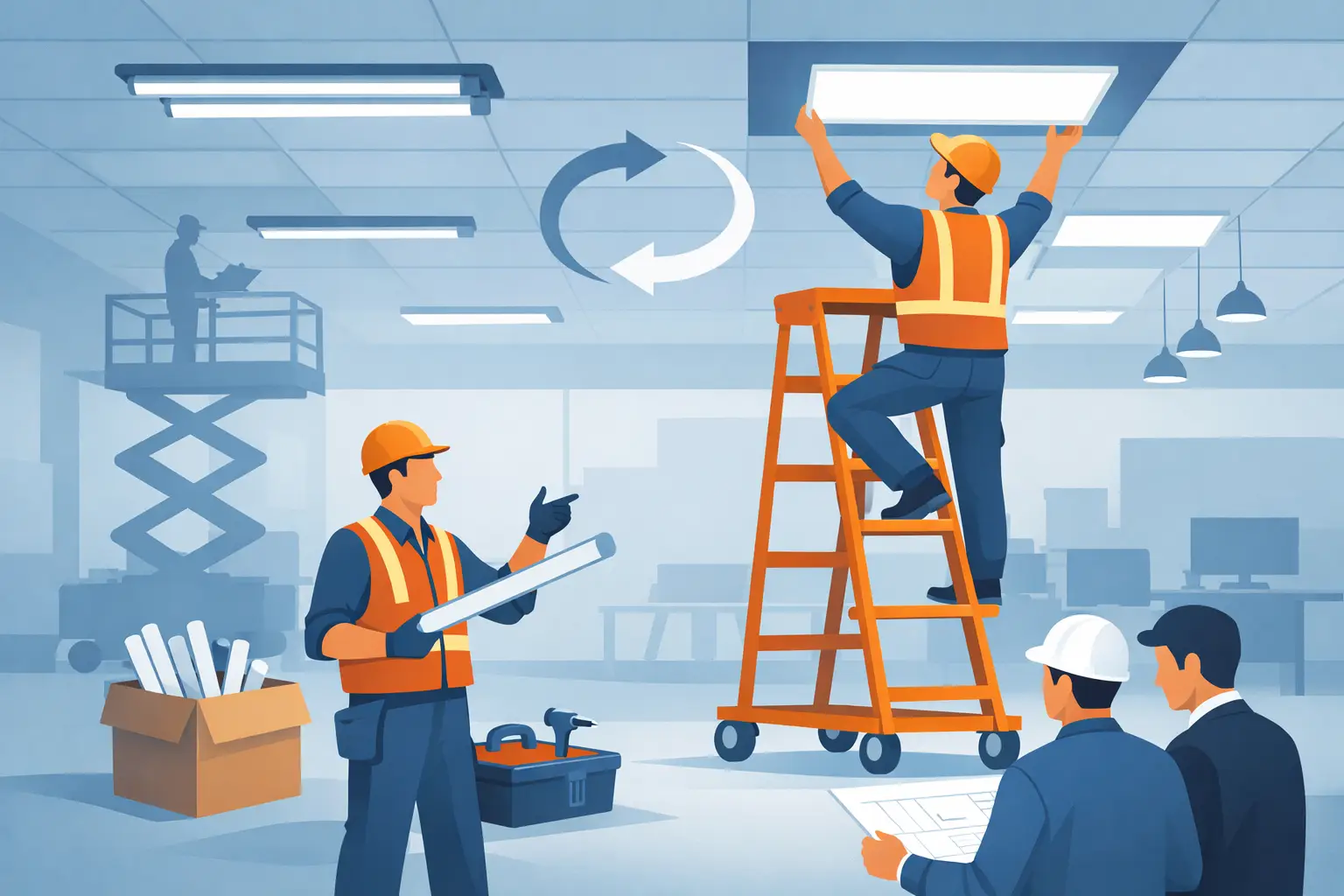
A lighting upgrade can look profitable on paper and still lose momentum once labor hits the estimate. That is usually where margins get squeezed, schedules slip, and facility teams start dealing with more disruption than expected. If you are evaluating how to reduce lighting labor, the real answer is not pushing crews harder. It is choosing retrofit methods, products, and project planning that remove unnecessary work from the job.
In commercial and industrial projects, labor is rarely just the installer’s hourly rate. It includes mobilization, lift time, fixture tear-down, wiring complexity, troubleshooting, cleanup, access coordination, and the cost of working around occupied spaces. The fastest path to lower labor is to simplify the job before the first fixture is opened.
How to reduce lighting labor starts with fixture strategy
Many retrofit projects get priced as if every fixture requires a full rebuild. In some cases, that is true. If housings are damaged, code requirements have changed, or the existing fixture layout no longer serves the space, a more involved replacement may be the right call. But in a large number of fluorescent-to-LED upgrades, the housing is still usable and the labor burden comes from the installation method, not the fixture itself.
That is why retrofit strategy matters so much. A well-designed retrofit kit can keep the existing housing, avoid unnecessary demolition, reduce disposal volume, and shorten time on the lift. Those savings compound quickly across a warehouse, school, office, parking structure, or manufacturing facility.
The key question is simple: are you paying labor to improve lighting, or paying labor to undo a fixture before you can improve it? The more steps required to strip, rewire, drill, mount, and reassemble, the more labor cost gets baked into the project.
Labor drops when installation steps disappear
The biggest gains usually come from removing steps, not trimming minutes from the same old process. If a retrofit requires tools for every component, extensive rewiring, or a licensed electrician for work that could be simplified, labor costs will stay high no matter how efficient the crew is.
This is where product design has a direct financial impact. Tool-free retrofit systems, magnetic mounting, preconfigured components, and simplified driver connections reduce handling time and limit the chance of install errors. That matters in every setting, but especially in facilities where access is difficult or downtime is expensive.
A kit that installs in a few minutes instead of requiring a fixture-by-fixture rebuild changes the economics of the entire project. It also changes who can perform the work. In the right application, reducing electrical complexity can allow existing maintenance personnel to complete installations rather than relying entirely on skilled electricians. For many facility owners and managers, that is one of the most practical ways to reduce lighting labor without compromising quality.
There is a trade-off, of course. Not every quick-install product is a good product. Some labor-saving designs cut corners on thermal management, optics, driver quality, or long-term reliability. If the result is callbacks, premature failures, or poor light performance, the labor savings disappear later. The right approach is to reduce installation steps while still using engineered products built for commercial duty.
Why retrofit kits often outperform full replacements on labor
Full fixture replacement has its place, but it often carries hidden labor that buyers underestimate. Crews may need to remove the existing fixture completely, patch or modify mounting points, address ceiling disruption, manage more packaging and waste, and rework branch connections. In occupied buildings, that can also mean more disruption to tenants, employees, or operations.
A retrofit kit changes the equation by preserving what is still valuable. The housing stays in place. The labor shifts from removal and replacement to conversion. That usually means less time per fixture, less mess, and less interruption.
For contractors, that creates a cleaner path to profitability. For owners and facility teams, it means shorter project windows and less impact on daily operations.
Product standardization reduces labor across the whole job
Another overlooked answer to how to reduce lighting labor is standardization. Mixed fixture types, inconsistent components, and one-off install methods force crews to slow down. Every time the process changes, productivity drops.
When a project is built around a consistent retrofit platform, crews learn the install once and repeat it at speed. Estimating gets cleaner. Material staging gets easier. Troubleshooting drops because there are fewer variables in play.
This is especially important on multi-site rollouts or large facilities with repeating fixture types. A standardized approach can shave meaningful time from every room, aisle, or bay. Over hundreds or thousands of fixtures, those minutes become budget.
It also improves project control. Purchasing knows what is needed. Supervisors can train crews faster. Facility teams know what they are inheriting. That is operational value, not just installation speed.
Better documentation saves labor too
Labor overruns do not only happen on ladders and lifts. They happen when crews arrive with incomplete counts, unclear compatibility, or missing installation guidance. A project that starts with poor fixture surveys usually pays for it later in confusion and delays.
Accurate pre-job documentation reduces wasted trips and field decisions. That includes confirming fixture types, voltages, mounting conditions, control needs, and any special environmental demands. It also helps identify where a retrofit kit is the right fit and where a full replacement is unavoidable.
The more certainty you create before material lands on site, the less labor gets burned solving preventable problems.
Occupied spaces demand low-intrusion solutions
In schools, healthcare environments, offices, retail spaces, and active industrial facilities, labor is not just about installation hours. It is also about how much the project interferes with the people using the building.
A labor-heavy approach often means larger work zones, longer disruptions, more noise, and greater scheduling complexity. If the facility has to coordinate after-hours access, move inventory, pause production, or work around tenants, the project cost rises beyond the electrical scope.
That is why low-intrusion retrofits matter. Faster installs reduce the time each area is affected. Cleaner conversions reduce debris and fixture handling. Simpler processes reduce the number of trades and return visits needed to finish the work.
For many commercial buyers, that operational impact is just as important as the labor line item. A retrofit that protects business continuity is usually worth more than one that only looks cheaper on material.
Rebates and ROI matter, but labor often decides the project
High efficacy, energy savings, and utility rebates are all important. They support payback and improve the financial case for an upgrade. But many projects stall because labor makes the proposal harder to approve.
That is why the best retrofit solutions balance energy performance with installation efficiency. A product with strong efficacy and rebate potential is valuable, but if it also installs quickly and simply, the return improves from both sides. Material performance lowers operating cost. Installation efficiency lowers project cost.
That combination is where retrofit projects become easier to sell internally and easier to execute in the field. It is one reason contractor-aware manufacturers have focused on install simplification rather than treating labor as someone else’s problem.
Optilumen built its retrofit approach around that reality, with tool-free magnetic retrofit kits designed to cut install time dramatically while delivering high efficacy and long-term performance. That kind of design thinking is what turns labor reduction from a talking point into a measurable jobsite advantage.
How to evaluate the best way to reduce lighting labor
If you are comparing products or planning a retrofit, start by looking at the labor path, not just the fixture spec sheet. Ask how many steps the install requires, whether the housing can stay in place, how much rewiring is involved, and whether the system can be installed by maintenance staff in appropriate applications.
Also look at repeatability. A labor-saving product should be easy to install once and just as easy on the hundredth fixture. It should reduce the chance of mistakes, not create new ones. And it should hold up over time so labor is not reintroduced later through failures and service calls.
There are projects where a full replacement is still the better answer. There are spaces where controls, code, fixture condition, or design goals justify a more involved scope. But when the objective is to upgrade fluorescent lighting efficiently in commercial and industrial environments, the smartest way to reduce labor is usually to reduce complexity.
That is the practical lens to bring to any lighting project: fewer steps, fewer interruptions, fewer callbacks, and more useful work completed per hour. When a retrofit solution is engineered around that goal, labor stops being the obstacle that kills the deal and starts becoming a source of savings you can actually keep.
Leave a Reply