
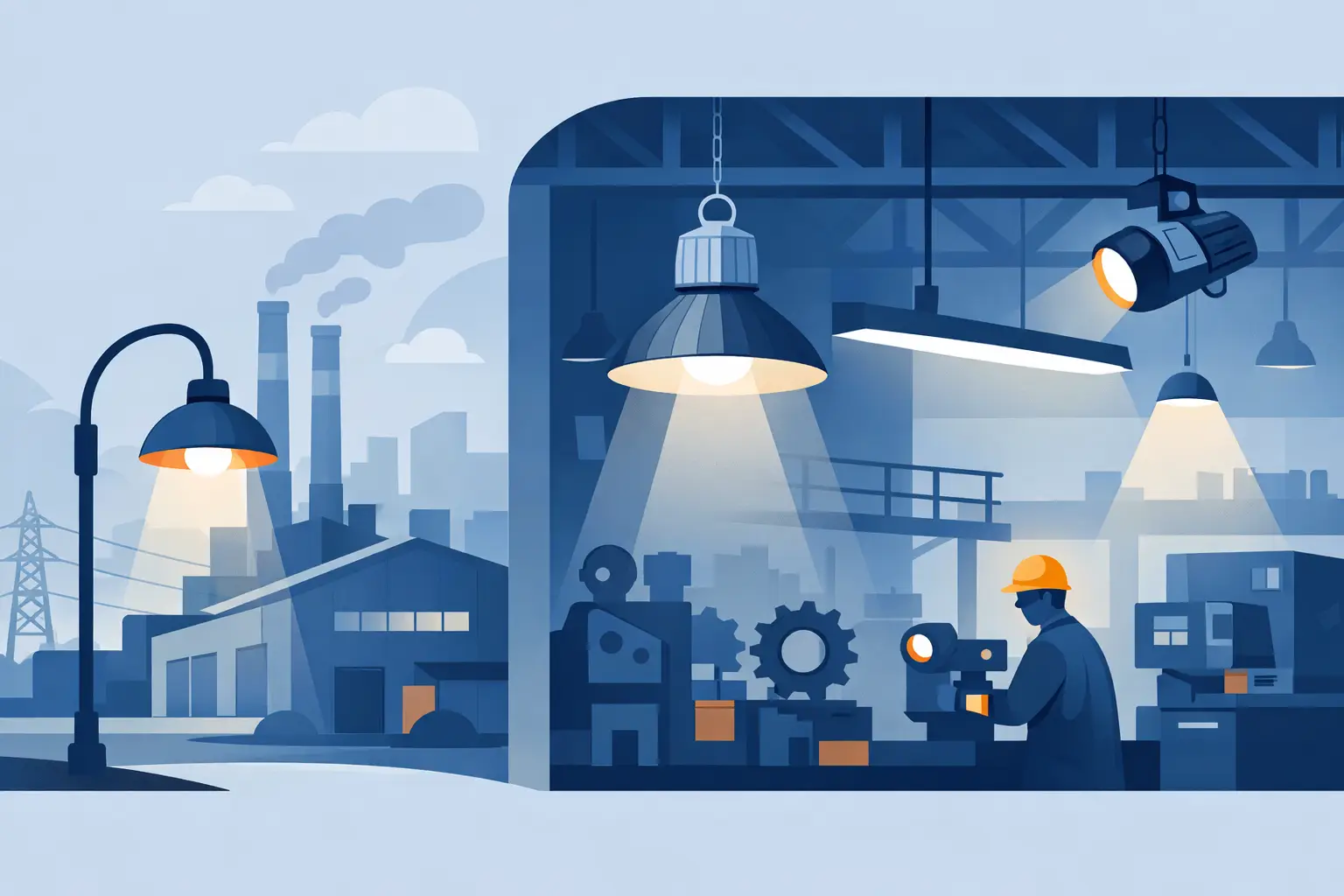
Walk into a warehouse with dim aisles, uneven light, and aging fluorescent fixtures, and the problem shows up fast – slower work, more maintenance calls, and a space that never feels fully operational. That is usually where the question starts: what is industrial lighting, and what makes it different from standard commercial fixtures? The short answer is that industrial lighting is built for demanding environments where performance, durability, efficiency, and visibility directly affect operations.
Industrial lighting is not just brighter lighting. It is a category of lighting systems designed for facilities such as warehouses, manufacturing plants, distribution centers, workshops, utility buildings, and other spaces where fixtures have to do more than simply illuminate a room. They need to withstand long operating hours, temperature variation, dust, vibration, moisture, high mounting heights, and maintenance constraints. In many cases, the right system also needs to support safer movement, better accuracy, and lower operating cost across a large footprint.
What is industrial lighting designed to do?
At a practical level, industrial lighting is meant to deliver reliable light in working environments where downtime costs money and poor visibility creates risk. In an office, lighting is mostly about comfort and appearance. In an industrial setting, lighting has a much tighter relationship to safety, productivity, and facility performance.
That means the fixture itself matters. Housing strength, thermal management, optical control, driver quality, and mounting method all carry more weight in industrial applications than they do in many standard indoor environments. A fixture may need to perform in a facility that runs multiple shifts, has airborne particulates, uses washdown procedures, or depends on high-bay output from ceilings 20 feet or higher.
This is also why industrial lighting projects are rarely just about replacing one lamp with another. Buyers are evaluating light levels, fixture spacing, maintenance access, installation labor, rebate potential, and return on investment. The right answer depends on how the building is used, not just what fixture looks good on paper.
Where industrial lighting is used
Industrial lighting is most commonly used in spaces where the work environment is active, equipment-heavy, or operationally sensitive. Warehouses and distribution centers are obvious examples because they need uniform light in aisles, loading areas, and staging zones. Manufacturing facilities often need higher task visibility, especially where assembly, inspection, or machine operation is involved.
It is also common in maintenance shops, fabrication spaces, cold storage areas, utility rooms, parking structures, and large back-of-house operations. Some commercial buildings have industrial lighting needs in only part of the facility. A retail site, for example, may use decorative or general commercial lighting in customer-facing areas and industrial-grade fixtures in stockrooms, service corridors, and receiving areas.
That distinction matters because fixture selection should follow application. A product that works well in a classroom or office ceiling grid may not hold up in a manufacturing plant with dust, heat, and extended run times.
Key features that define industrial lighting
The best way to understand industrial lighting is to look at the job it has to perform over time. Light output is one factor, but not the only one. Industrial fixtures are usually specified around a combination of durability, efficiency, and site-specific control.
High output is often required because many industrial facilities have tall ceilings and wide open floor plans. Fixtures need enough punch to deliver useful illumination at the task plane without wasting light. Optics matter here. A poorly controlled beam can create bright spots, shadows, or glare, especially in racking aisles or production zones.
Durability is another defining characteristic. Industrial environments can be hard on fixtures. Heat buildup, vibration from machinery, dust accumulation, or moisture exposure can shorten life if the product is not engineered for those conditions. This is one reason buyers increasingly prefer purpose-built LED systems over older lamp-based technologies.
Maintenance also carries more weight in industrial applications. If a fixture is mounted high above an active production line or warehouse aisle, every service event comes with labor cost, access equipment, and operational disruption. Longer-life lighting reduces that burden, but only if the product is designed well enough to hold performance over time.
Why LED changed industrial lighting
For years, industrial spaces were commonly lit with fluorescent, metal halide, or high-pressure sodium systems. Those technologies did the job, but they came with trade-offs: lower efficiency, more frequent lamp replacement, slower startup, color inconsistency, and declining performance over time.
LED changed the economics and the practicality of industrial lighting. Better LED systems provide higher fixture efficacy, stronger light quality, longer service life, and far lower maintenance demand. They also perform better with controls, which helps facilities reduce wasted energy in areas that are vacant or only used part-time.
The shift to LED is not only about utility savings. In many buildings, the biggest gain comes from combining energy reduction with lower labor cost and less disruption. A retrofit that installs quickly and minimizes the need for licensed electrical labor can change project economics in a meaningful way, especially across large facilities. That is why many industrial buyers now look beyond fixture wattage and focus on total installed cost, rebate value, and long-term performance.
What is industrial lighting in a retrofit project?
In real-world facilities, industrial lighting often means retrofit rather than full new construction. The building already has fixtures in place, usually fluorescent high bays, strips, wraps, or troffers, and the goal is to modernize performance without creating unnecessary labor or downtime.
A well-designed retrofit keeps what still has value and replaces what is limiting performance. That approach can lower material waste, speed installation, and reduce intrusion into active spaces. For facility managers and contractors, this is often the difference between a project that pencils out and one that gets delayed.
Retrofit quality, however, varies widely. Some products promise quick upgrades but create problems with fit, thermal performance, or inconsistent light output. Others are engineered around field realities, with installation methods that reduce labor and designs that improve fixture efficacy rather than simply changing the light source. In industrial settings, those details matter because the scale of the project magnifies every inefficiency.
Optilumen built its retrofit approach around that reality, with tool-free magnetic retrofit kits designed to install fast, reduce labor pressure, and deliver very high efficiency. For buyers managing aging fluorescent systems, that kind of design thinking can have just as much value as the energy savings themselves.
How to evaluate industrial lighting the right way
A common mistake is judging industrial lighting by upfront fixture price alone. That may work for a small, low-use area. It usually falls apart in a large facility where lights run long hours and maintenance is expensive.
A better evaluation starts with application. Ceiling height, operating hours, ambient conditions, code requirements, and task visibility should shape the lighting plan first. From there, it makes sense to compare fixture efficacy, expected life, light distribution, color quality, and installation method.
Labor is often underestimated. If one product saves a few dollars on purchase price but takes significantly longer to install, requires electricians for every step, or disrupts an active workspace, the cheaper fixture may become the more expensive choice. The same goes for maintenance exposure. In high-bay environments, avoiding repeat service events has real financial value.
Rebates and energy incentives should also be considered early, not as an afterthought. Higher-performing systems often qualify for stronger incentives, which can improve payback considerably. Still, rebate eligibility should support the project, not drive it. The product has to work operationally first.
Why industrial lighting affects more than visibility
Good industrial lighting changes how a space functions. It improves visual clarity around equipment, inventory, and floor conditions. It can help reduce errors in picking, assembly, and inspection. It supports safer movement for workers and material handling equipment. It also makes facilities feel better maintained, which can influence how a site is perceived by employees, inspectors, and customers.
There is a human side to this as well. Harsh glare, poor uniformity, and weak color rendering can wear on people over the course of a shift. Better lighting does not solve every operational issue, but it can remove a daily friction point that affects comfort and attention.
At the same time, there is no single best industrial lighting solution for every building. A warehouse aisle, a food processing area, and a machine shop may all need different fixture types, optics, and protection levels. The right answer depends on the environment, the workflow, and the cost structure of the project.
Choosing industrial lighting with long-term value in mind
If you are defining a lighting upgrade, it helps to treat industrial lighting as an operational asset rather than a line-item purchase. The fixture should support how the building runs today and how it will be maintained over the next decade. That means looking at installation practicality, real efficiency, product quality, and how much disruption the upgrade will create.
When those factors are aligned, industrial lighting becomes more than a utility reduction project. It becomes a way to improve the work environment, lower maintenance strain, and make capital spending produce measurable results. That is the standard worth aiming for, especially in facilities where lighting is expected to perform every day without excuses.
The best industrial lighting choice is usually the one that fits the space, installs without unnecessary friction, and keeps delivering value long after the project is finished.