
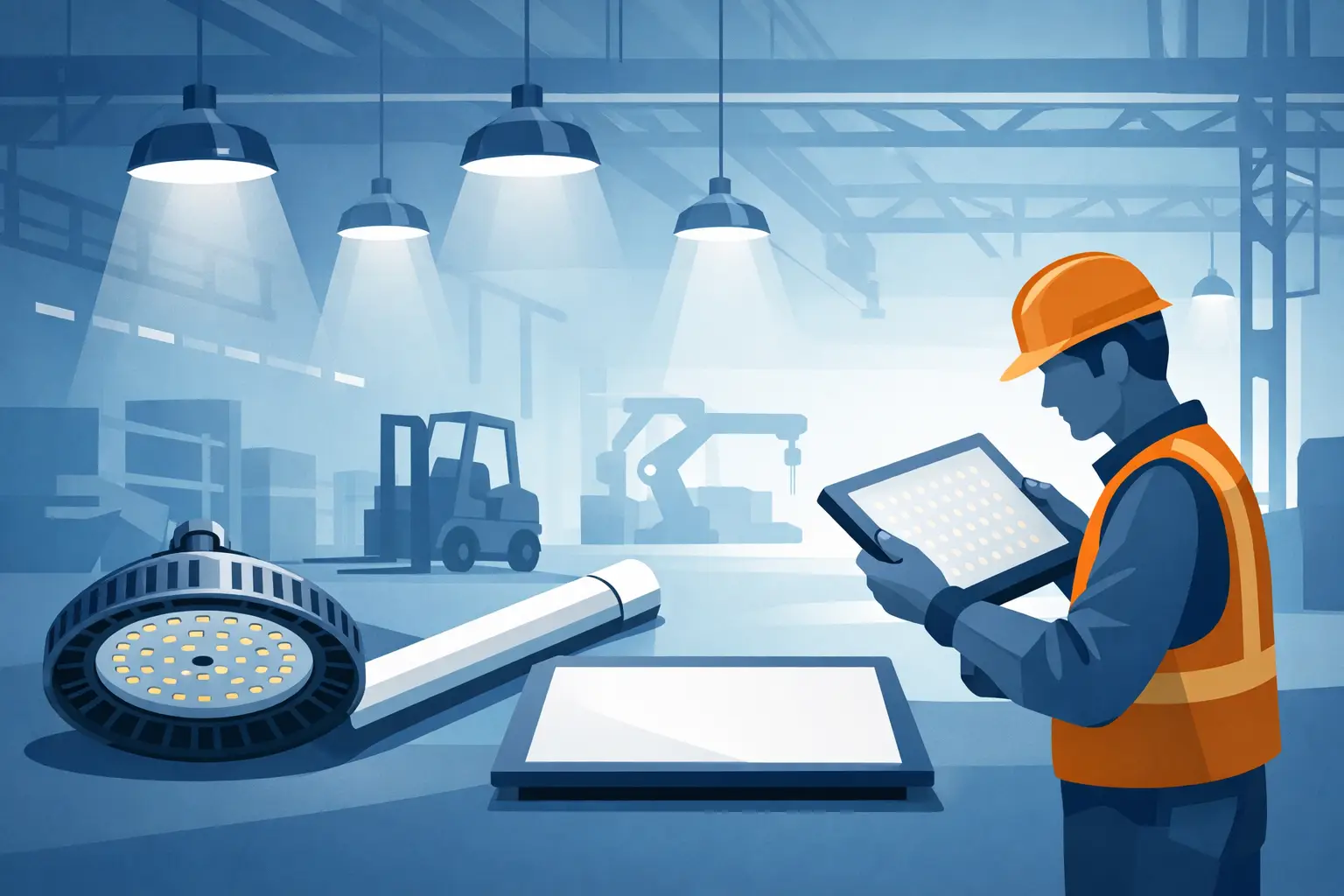
A bad industrial lighting decision usually does not fail on day one. It shows up later as higher utility bills, slow installs, callback headaches, uneven light on the floor, and fixtures that looked fine on paper but do not hold up in real operating conditions. That is why selecting the right led light for industrial use is less about chasing specs in a catalog and more about choosing a system that works for the facility, the crew, and the budget over time.
In industrial spaces, lighting is tied directly to operations. Warehouses need visibility across aisles and rack faces. Manufacturing floors need consistent light for safety, accuracy, and productivity. Maintenance teams need products that can be installed fast and serviced without creating unnecessary downtime. Buyers are not just purchasing light output. They are purchasing labor efficiency, energy performance, reliability, and risk reduction.
What matters most in an LED light for industrial use
The first question is not simply how many lumens a fixture produces. The better question is how the entire lighting solution performs in the building where it will actually be used. Industrial buyers often compare wattage, price, and lumen output first, but those numbers only tell part of the story.
Fixture efficacy matters because it affects operating cost year after year. A high-efficacy system can materially lower energy consumption and increase rebate potential. That said, efficacy should not be evaluated in isolation. A product can post attractive numbers and still create problems if it is difficult to install, poorly designed for the existing fixture layout, or inconsistent in quality.
Installation method also deserves more attention than it usually gets. In a working industrial environment, labor cost can rival or exceed product cost. If a retrofit requires extensive rewiring, fixture modification, or licensed electrical labor for every unit, the economics can shift quickly. On paper, a cheaper product may look competitive. In the field, it may become the more expensive option.
Then there is longevity. Industrial facilities do not want to revisit the same lighting project in a few years because of early failures, mismatched components, or declining performance. Long life is not only about the LED chips. It is also about thermal design, driver quality, and whether the product was engineered for real commercial duty rather than commodity distribution.
New fixtures versus retrofit solutions
For many facilities, the right answer is not a full fixture replacement. A retrofit can deliver stronger economics when the existing housing is still serviceable and the goal is to improve performance without creating unnecessary disruption.
A full replacement may make sense when fixtures are damaged, layouts need to change, or the existing housings are not worth keeping. It can also be the cleaner path in highly specialized environments where optics, controls, or mounting requirements are changing significantly. But replacement is not automatically the best choice just because the building has older fluorescent systems.
A retrofit often reduces project cost, shortens installation time, and limits intrusion into active workspaces. That matters in warehouses with constant movement, production facilities with narrow maintenance windows, and occupied spaces where downtime affects revenue. For contractors and facility teams, retrofit can also simplify project execution by reducing demolition, disposal, and coordination.
This is where product design makes a real difference. A retrofit system built for speed and simplicity can change the labor model of a project. If installation can be completed in minutes rather than requiring a drawn-out fixture rebuild, the savings are not theoretical. They show up in bids, schedules, and labor allocation.
Why labor efficiency changes the ROI
Many industrial lighting calculations focus almost entirely on utility savings. Energy reduction is important, but it is only one part of total return. Labor efficiency can dramatically improve project economics, especially across large facilities with hundreds or thousands of fixtures.
If a lighting system installs quickly and does not require highly specialized labor, project cost drops. If maintenance staff can handle much of the work safely and efficiently, scheduling becomes easier and dependence on outside crews is reduced. If the installation process limits disruption to the facility, operations can continue with less interference.
Those factors matter because industrial projects rarely happen in empty buildings. They happen in active environments with forklifts, inventory, production targets, sanitation schedules, and safety requirements. A product that saves time in those conditions delivers value that goes beyond the electric bill.
For that reason, contractor-aware design should not be treated as a secondary feature. It is central to profitability. Optilumen built its reputation around that reality, with retrofit systems engineered to reduce complexity, speed installation, and support stronger long-term savings.
Efficiency is important, but so is usable light
A high-performance LED light for industrial use should lower wattage while improving visibility where people actually work. That means buyers need to think beyond raw output and ask how light is distributed in the space.
In warehouse aisles, vertical illumination can be just as important as horizontal light levels because workers need to identify labels and product on shelving. On manufacturing floors, consistency matters because shadows and uneven brightness can affect inspection tasks and operator comfort. In utility or back-of-house areas, the priority may be straightforward reliability and low maintenance rather than a highly tailored optical package.
Color temperature and color rendering also depend on the use case. Cooler color temperatures are often preferred in industrial settings because they support a crisp, alert visual environment. But there are trade-offs. In some spaces, an overly harsh feel is not ideal, especially if the lighting also affects adjacent office, service, or mixed-use areas. Good planning balances efficiency with how the space is actually used.
Rebates, payback, and the real project math
Utility rebates can significantly improve payback, especially when fixture efficacy is high. But rebate potential varies by region, utility program, and product qualification. That is why the best lighting choice is not always the fixture with the lowest purchase price. In many projects, a more efficient system can secure stronger incentives and produce a better net cost after rebates are applied.
This is where experienced buyers separate first cost from total cost. A product with stronger efficacy, longer life, and faster installation may produce the best overall return even if the unit price is higher. The reverse is also true. A low-cost option that creates labor inefficiency or weak long-term performance can erode savings quickly.
The most useful approach is to evaluate the full project equation: product cost, labor cost, expected utility savings, maintenance reduction, rebate value, and operating life. When those numbers are viewed together, the right decision often becomes clearer.
Common mistakes buyers make
One common mistake is buying on spec-sheet output alone. Another is assuming all LED products in the same category will deliver similar results. Industrial lighting quality varies widely, and the difference usually appears after installation, not before.
A second mistake is underestimating labor. A system that seems inexpensive can become costly if it takes too long to install or requires more skilled labor than expected. This is especially relevant in retrofit projects where speed and simplicity can determine whether the job remains profitable.
A third mistake is treating industrial facilities as if they all have the same needs. A logistics warehouse, food processing plant, automotive service center, and manufacturing line may all need durable lighting, but the right solution is not identical in each setting. Layout, ambient conditions, operating hours, maintenance access, and workflow all affect product selection.
How to evaluate an industrial LED supplier
The product matters, but the manufacturer matters too. Industrial buyers need more than a box with a label. They need a supplier that understands field conditions, contractor workflow, and the financial pressure behind lighting upgrades.
A credible manufacturer should be able to explain not just what the fixture does, but why it was engineered that way and where it fits best. The strongest partners understand installation realities, offer dependable product consistency, and support projects with practical guidance rather than generic marketing claims.
That is particularly important in retrofit work. A retrofit solution should be designed around the problems contractors and facility teams actually face: time, access, labor, quality control, and the need to deliver measurable savings without overcomplicating the project.
Choosing for the next decade, not the next quarter
Industrial lighting decisions tend to stay in place for a long time. That is why the best choice is usually the one that reduces operational friction over the full life of the system. Better efficiency matters. Better light quality matters. But easier installation, reliable performance, and lower long-term maintenance often decide whether a project feels like a smart investment years later.
If you are evaluating LED lighting for an industrial facility, focus on the full outcome. Look at how the system installs, how it performs in your actual environment, what it does for labor and rebate opportunities, and how likely it is to stay out of your maintenance queue. The right product should make the project easier to execute and cheaper to live with. That is usually the clearest sign you chose well.