
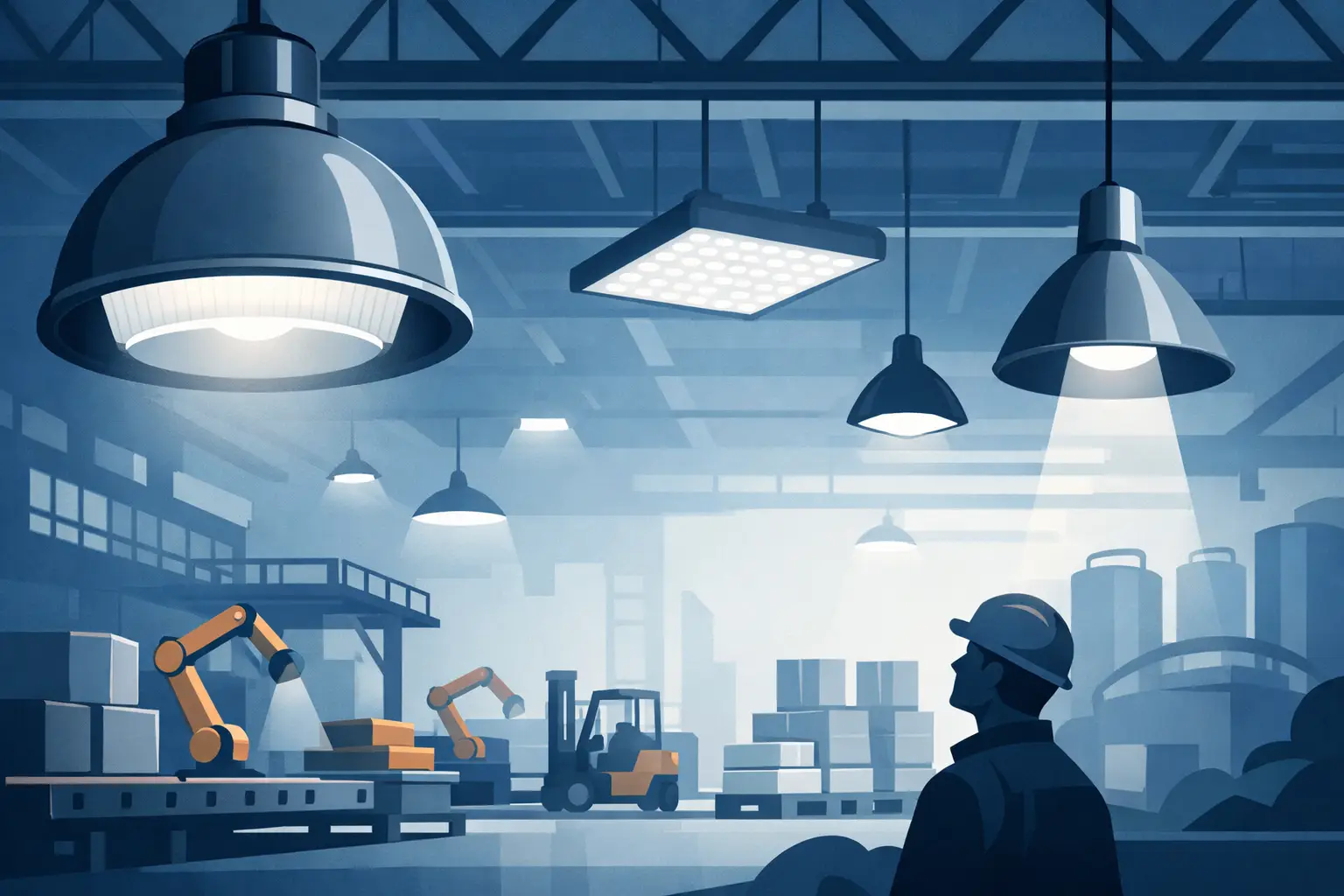
A warehouse can hit its production targets and still lose money every day because the lighting is wrong. Missed pick accuracy, maintenance calls, uneven light in work zones, and high fixture failure rates all add up fast. That is why industrial lighting requirements are not just a code or spec issue. They directly affect throughput, safety, labor efficiency, and long-term operating cost.
In industrial facilities, lighting decisions usually sit at the intersection of engineering, operations, maintenance, and budget. That makes the conversation more complicated than choosing a brighter fixture. The right system has to support the tasks being performed, fit the existing infrastructure, reduce installation friction, and deliver measurable savings without creating new maintenance problems.
What industrial lighting requirements actually include
When people talk about industrial lighting requirements, they often mean foot-candle targets. That matters, but it is only one part of the job. A lighting system also needs to provide consistent coverage, control glare, support visual accuracy, hold up in the environment, and meet the operational needs of the building.
A manufacturing floor, distribution center, cold storage facility, and maintenance shop may all be industrial spaces, but they do not share the same lighting needs. Fine assembly work calls for different light levels than bulk storage. Forklift traffic needs clear visibility in aisles and intersections. Inspection areas need better color rendering than general warehouse zones. The requirement is not just illumination. It is fitness for use.
That is where many projects go off track. A low-cost fixture may look acceptable on paper because it hits a wattage target, but if it creates hot spots, dark rows, or poor vertical visibility, the facility still pays for a bad result.
Start with the task, not the fixture
The most effective way to evaluate industrial lighting requirements is to begin with how the space is actually used. Task type should drive the lighting plan. In a warehouse, workers may need to read labels at rack level, distinguish packaging details, and move equipment safely through narrow aisles. In a production setting, they may need stronger illumination over workstations and less emphasis in surrounding areas.
This is also why one-size-fits-all replacement plans usually underperform. Uniform fixture swaps can miss critical differences between spaces with different ceiling heights, reflectance levels, obstruction patterns, and visual demands. A facility that mixes storage, staging, packaging, and quality control may need different light distribution strategies within the same building.
Good planning also means looking beyond average light levels. Uniformity matters because people work across the whole area, not just under the brightest point. If workers move from bright zones into shadowed ones, visibility and comfort both suffer.
Safety and code are the baseline, not the finish line
Industrial lighting has obvious safety implications. Poor visibility contributes to trips, misreads, equipment handling errors, and fatigue. In facilities with moving machinery, loading docks, or forklift traffic, weak lighting can create risk that is avoidable.
Code compliance is part of the picture, but it should not be treated as the finish line. Emergency egress, electrical safety, and local energy code requirements are mandatory. Still, a code-compliant system can fall short operationally if it does not match the real visual conditions on the floor.
For example, glare can be a serious issue in high-bay applications. If operators are looking up toward bright sources while handling material, visibility may get worse even when measured light levels appear sufficient. Similarly, spaces with dust, moisture, vibration, or temperature swings need fixtures designed for those conditions. A fixture that works in a clean commercial ceiling may not last in an industrial environment.
Efficiency matters, but so does usable light
Energy savings usually drive retrofit conversations, and for good reason. Industrial facilities often have long burn hours, large fixture counts, and meaningful rebate opportunities. The savings potential is real. But fixture efficacy alone does not tell the full story.
What matters is how efficiently the system turns power into useful light where work happens. A high-efficacy product with poor optical control can waste light above the task plane or create uneven distribution that forces over-lighting elsewhere. In practice, that can reduce the value of the upgrade.
This is why layout, optics, mounting height, and application fit matter just as much as watts and lumens. The goal is not simply lower energy use. The goal is lower energy use while improving visual performance and reducing maintenance burden.
In retrofit projects especially, the best result often comes from balancing fixture performance with installation reality. A product that saves a little more energy but requires major labor, disruption, or rewiring may not deliver the best return. In many industrial sites, labor cost and downtime carry as much weight as fixture price.
Industrial lighting requirements in retrofit projects
Most industrial buildings in use today were not designed around current LED performance. Many still rely on fluorescent, HID, or aging early-generation LED systems. That makes retrofit the practical path for a large share of facilities.
Retrofit projects have their own version of industrial lighting requirements. The new system has to improve output and efficiency, but it also has to work within the existing fixture footprint, building schedule, and maintenance capabilities. If installation requires shutting down sensitive areas, bringing in specialized labor, or rebuilding housings unnecessarily, project cost rises quickly.
That is one reason retrofit design matters so much. A well-engineered retrofit solution can reduce installation time, limit disruption, and improve consistency across the building. For contractors and facility teams, that often translates directly to better project economics.
This is also where manufacturer experience shows. Products built with field installation in mind tend to reduce surprises. Easier handling, simpler wiring, and predictable fit can make the difference between a clean rollout and a project that burns labor hours. Optilumen has built its retrofit approach around that reality, which is why installation speed and fixture efficiency are both central to the value equation.
The specifications buyers should examine closely
Industrial buyers should look past headline claims and ask practical questions. How much light reaches the actual work area? What is the expected life under real operating conditions, not just laboratory assumptions? How stable is output over time? What kind of thermal management supports that life expectancy?
Color temperature and color rendering also deserve attention. Cooler color temperatures are common in industrial spaces because they support perceived brightness and visual clarity, but there is no universal answer. The right choice depends on the task and environment. A space focused on visual inspection may need better color rendering than a bulk storage area.
Controls can improve savings, but only when they fit the operation. Occupancy sensors and daylight harvesting can work well in certain industrial environments, yet they can also create frustration if they are poorly commissioned or mismatched to the workflow. In active facilities, reliability and predictability usually matter more than adding every available control feature.
Warranty support, product consistency, and manufacturer responsiveness should also be part of the evaluation. Industrial projects are rarely one-and-done purchases. Buyers need confidence that the product line will perform consistently and that support will be there if issues come up later.
Why the lowest price often becomes the highest cost
Industrial lighting is a long-horizon decision. A cheaper product can look attractive at bid stage, especially when budgets are tight, but the total cost picture usually shows up later. Failure rates, poor driver quality, inconsistent output, and labor-heavy maintenance all erase apparent savings.
There is also the cost of compromised installation. If a product is difficult to mount, slow to wire, or inconsistent from fixture to fixture, the field crew pays for it first. Then the owner pays for it over time. In industrial settings, where fixture counts are high and access can be difficult, small inefficiencies multiply fast.
The better approach is to evaluate value across the full lifecycle – installation labor, rebate capture, energy reduction, maintenance intervals, and lighting quality on the floor. That is the standard that usually separates engineered lighting solutions from commodity product.
A better way to think about industrial lighting requirements
Industrial lighting requirements should be treated as operational requirements. The right system supports safer movement, clearer task visibility, easier maintenance, and stronger financial performance over time. It should fit the building, the work, and the people responsible for keeping the facility running.
If a lighting upgrade reduces energy use but creates installation headaches or leaves critical work areas underlit, it missed the mark. If it improves visibility but drives unnecessary project cost, it still needs a better plan. The strongest outcomes come from matching performance, install simplicity, and long-term reliability to the actual demands of the site.
That is the lens worth using before the first fixture is ordered. Good industrial lighting is not just brighter or newer. It is built to make the facility work better every day.