
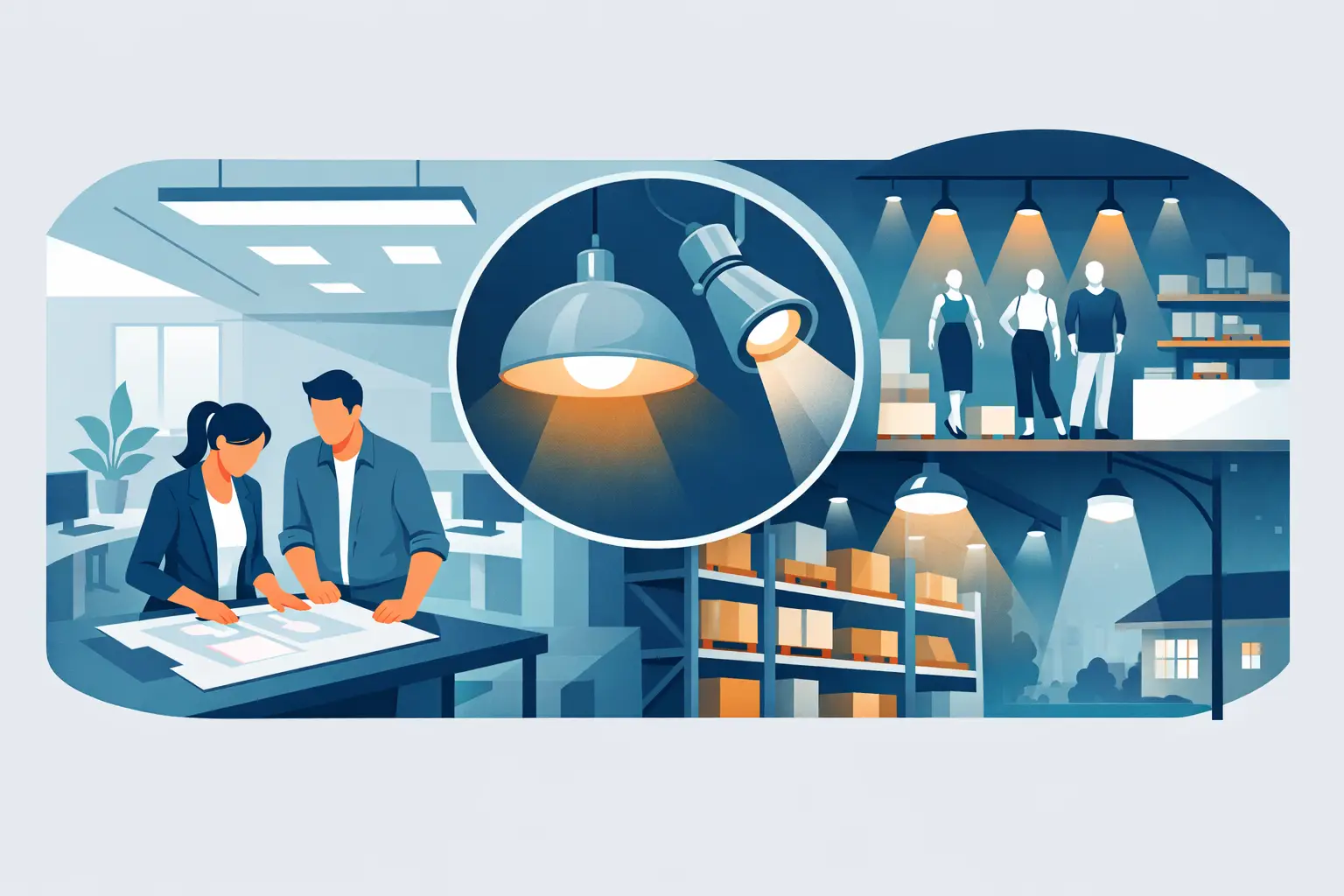
A lighting project usually gets expensive in the same place it gets delayed – after someone realizes the existing fixtures, controls, or light levels do not meet the real needs of the space. That is why commercial lighting requirements should be addressed early, before product selection, labor planning, or rebate assumptions are locked in.
For contractors, facility teams, and property owners, the goal is not just to make a building brighter. It is to deliver lighting that satisfies code, supports the task, controls energy use, and holds up over time. In many buildings, especially older ones with fluorescent systems, the best answer is not a full fixture replacement. A well-engineered retrofit can meet performance targets with less disruption, lower labor, and a faster return.
What commercial lighting requirements actually include
When people talk about commercial lighting requirements, they often mean several different things at once. One layer is code compliance, including energy codes, local amendments, and safety standards. Another is application performance, such as foot-candle targets, glare control, color quality, and uniformity. The third is operational practicality – how fast the system installs, how it is maintained, and what it costs over its service life.
Those layers overlap. A warehouse, office, school, medical space, and retail environment may all need efficient lighting, but the requirements are not interchangeable. A fixture package that works well in a back-of-house storage area may be a poor fit for classrooms or open offices where visual comfort matters more. The right approach depends on ceiling height, task type, occupancy patterns, utility rates, and how sensitive the space is to installation downtime.
Code and energy standards drive the baseline
The first checkpoint is code. Most commercial projects are influenced by state or local energy codes, and many jurisdictions follow some version of IECC or ASHRAE 90.1. These standards typically address lighting power density, controls, shutoff requirements, occupancy sensing, daylight response, and in some cases exterior lighting limits.
That does not mean every project starts from scratch. In retrofit work, the scope matters. Some simple lamp and ballast replacements may trigger fewer requirements than a broader renovation. But once controls are altered, fixtures are substantially upgraded, or permits are required, code obligations can change quickly. This is where many projects get tripped up. A product may look efficient on paper, yet still create a compliance issue if the controls strategy is incomplete.
For that reason, lighting selection should not happen in isolation. Fixture efficacy, driver compatibility, dimming capability, and control integration all affect whether the final installation meets the code path for that building.
Light levels matter, but so does light quality
Meeting target light levels is one of the most visible parts of the job, but it is not the whole job. Too little light creates safety and productivity problems. Too much light wastes energy and can make a space uncomfortable. Good commercial lighting is not just about output. It is about putting the right amount of light in the right place.
In office settings, balanced illumination and reduced glare are usually more valuable than raw brightness. In industrial environments, vertical illumination, visibility around equipment, and fixture durability may take priority. In retail, color rendering and beam control can affect how products look and how the space feels to customers. In schools and healthcare environments, consistency and comfort often matter as much as efficiency.
This is where photometric planning earns its keep. A fixture with high lumen output may still perform poorly if spacing, optics, or mounting conditions are wrong. Conversely, an efficient retrofit can often improve the visual environment when it is designed around the fixture geometry and room layout rather than treated as a simple lamp swap.
Controls are now part of the requirement, not an upgrade
A lot of older buildings still treat controls as optional. Current commercial practice does not. Occupancy sensors, scheduling, daylight harvesting, and dimming are commonly expected because they directly affect code compliance and operating cost.
The practical question is how much control is worth installing for the space. A private office, conference room, corridor, warehouse aisle, and parking structure do not need the same strategy. More control capability is not always better if it adds cost and complexity without meaningful savings. On the other hand, skipping controls where they are required or clearly justified can erase the financial benefit of an otherwise efficient LED conversion.
For contractors and facility managers, reliability matters just as much as features. If controls are difficult to commission or create service headaches, the savings story gets weaker. The better systems are the ones that align with how the space is actually used and can be maintained without turning every future service call into a troubleshooting exercise.
Retrofit vs. full replacement
One of the biggest decisions in meeting commercial lighting requirements is whether to replace the whole fixture or retrofit the existing housing. There is no universal answer. If fixtures are damaged, poorly located, or unsuitable for the application, replacement may be the right path. If the housing is sound and the layout already works, retrofit often delivers a better financial result.
That is especially true in fluorescent-to-LED upgrades. Retrofit solutions can reduce labor, preserve ceilings, limit disruption, and still deliver major improvements in efficacy, light quality, and maintenance life. In occupied buildings, that lower level of intrusion can matter as much as the energy savings. Schools, healthcare spaces, offices, and active industrial facilities do not always have the flexibility for long shutdown windows or messy ceiling work.
This is where product design matters. A retrofit that installs quickly, fits consistently, and does not require highly specialized labor can change the economics of the whole project. Optilumen built its retrofit approach around that field reality, which is why installation time and fixture efficacy are not side notes. They directly affect labor cost, rebate value, and speed to ROI.
Maintenance and lifecycle cost are part of the requirement
A cheap lighting upgrade that creates service problems is not a successful project. Commercial buyers have to think beyond first cost. Driver quality, thermal performance, component consistency, and long-term lumen maintenance all affect the real cost of ownership.
This is one reason very low-priced commodity products often disappoint in commercial settings. On paper, they may seem to satisfy the immediate requirement for LED conversion. In practice, inconsistent color, early failures, poor fit, and limited manufacturer support can turn a low bid into a recurring expense.
For distributors, contractors, and owners, this becomes a margin and credibility issue. If callbacks increase or replacement cycles shorten, the project stops performing financially. The better question is not “What is the cheapest compliant option?” It is “What solution will still look smart after years of operation, maintenance, and utility savings are accounted for?”
Commercial lighting requirements by space type
Different spaces put pressure on different parts of the lighting plan. Warehouses and industrial sites often prioritize high efficacy, dependable output, and reduced maintenance at mounting heights where service is costly. Offices usually need a better balance of comfort, controls, and visual consistency. Retail spaces lean harder on presentation, color quality, and customer experience. Schools and public buildings often need a low-disruption path that can be phased around occupancy.
That is why a one-size-fits-all package rarely performs well across a property portfolio. Even within the same building, breakrooms, production areas, corridors, storage rooms, and administrative spaces may need different optics, controls, or color temperatures. The strongest projects treat lighting as an operational tool, not just a line item.
What buyers should verify before approving a project
Before a project moves forward, confirm that the lighting plan addresses actual code scope, target light levels, controls requirements, rebate assumptions, and installation logistics. Also verify how the chosen product will be serviced, what warranty support looks like, and whether the manufacturer understands retrofit conditions in the field.
That last point matters more than many buyers realize. A manufacturer that designs around contractor and maintenance realities can prevent a lot of downstream friction. Fit, install time, driver access, fixture performance, and documentation all affect whether the project stays profitable and manageable.
The best commercial lighting decisions are rarely the flashiest ones. They are the ones that satisfy the real requirements of the space, reduce labor where possible, and keep delivering value long after the install crew leaves. If a lighting upgrade solves code, energy, maintenance, and installation challenges at the same time, it is doing what commercial lighting is supposed to do.