
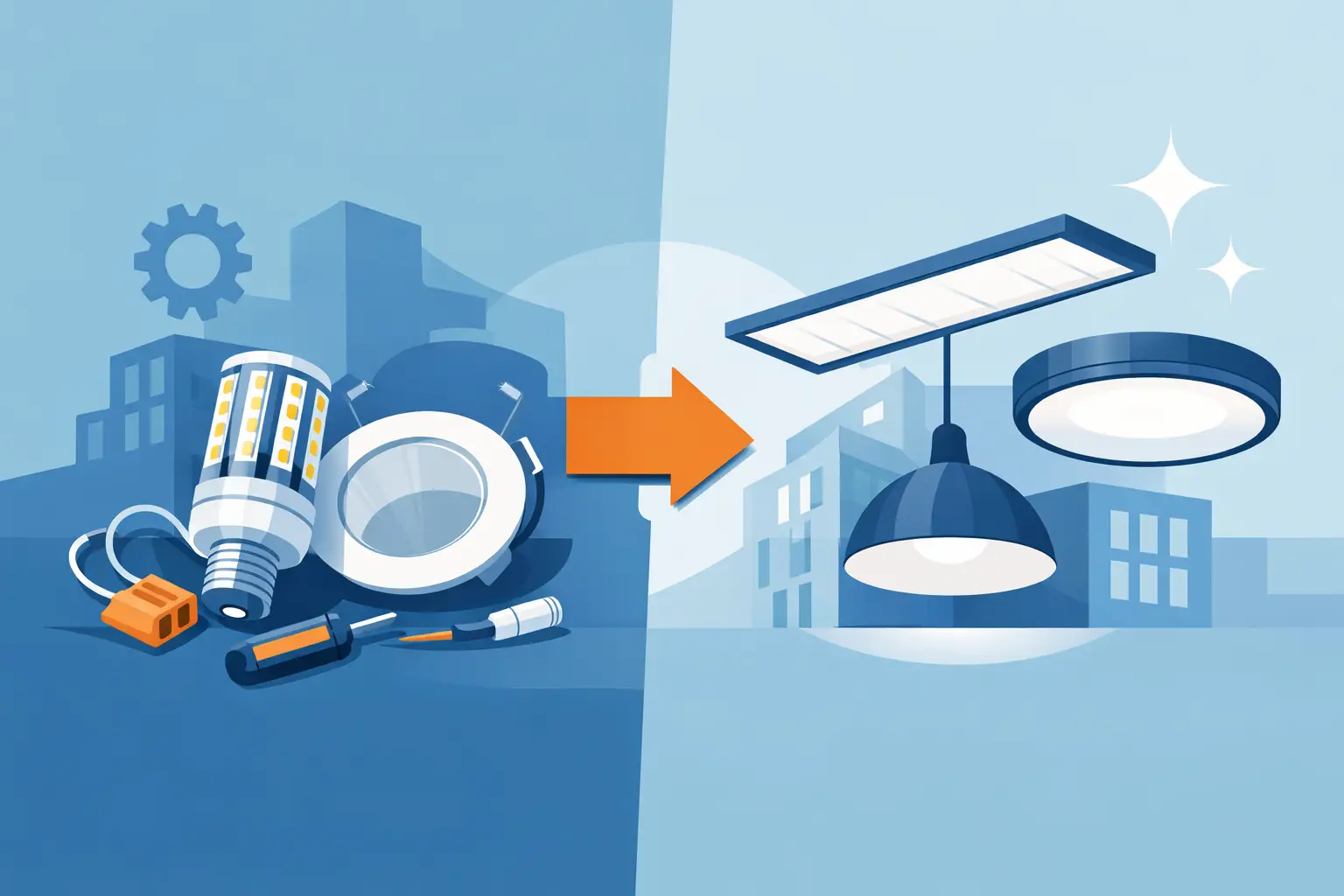
When a facility is still running fluorescent lighting, the decision usually comes down to one practical question: retrofit kits vs new fixtures. On paper, both can move a building to LED. In the field, though, the right choice depends on labor, rebate structure, fixture condition, installation disruption, and how much value you can keep from what is already in the ceiling.
For many commercial and industrial projects, the mistake is treating this as a simple product comparison. It is really a project execution decision. The best option is the one that lowers total installed cost, delivers reliable light quality, and fits the realities of the building without creating avoidable labor or downtime.
Retrofit kits vs new fixtures: the real difference
A retrofit kit upgrades the inside of an existing fixture while keeping the housing in place. In most fluorescent-to-LED projects, that means removing lamps and legacy components, then installing LED light engines, drivers, and mounting hardware designed to fit the existing fixture body.
A new fixture replacement means removing the entire existing luminaire and installing a complete new LED fixture. That can be the better route when the old housing is damaged, poorly sized for the space, or no longer worth keeping.
That distinction matters because fixture replacement is not just a lighting decision. It often becomes a ceiling, wiring, labor, and scheduling decision. In occupied offices, schools, warehouses, healthcare spaces, and production environments, every extra minute above the ceiling has a cost.
Where retrofit kits usually make more sense
If the existing fixture housing is structurally sound and the layout already works for the space, retrofit kits often have the advantage. You keep the fixture body, avoid unnecessary tear-out, and shorten the installation process.
That labor difference is not minor. On projects with hundreds or thousands of fixtures, a few minutes saved per unit can change the economics of the entire job. Faster installs reduce labor cost, simplify scheduling, and minimize disruption for tenants, staff, patients, or operations.
Retrofit kits also tend to perform well in facilities that want an upgrade without changing the look of the ceiling line. For property managers and facility teams, that can be valuable in offices, corridors, classrooms, and common areas where the existing footprint is clean and consistent.
Another major factor is rebates. High-efficacy retrofit systems can qualify for strong utility incentives, which improves payback and makes the business case easier to approve. When the retrofit product is engineered for maximum efficiency, the savings show up twice – once in energy use and again in incentive value.
When new fixtures are the better choice
There are times when replacing the whole fixture is the smarter move. If the existing housing is rusted, broken, badly stained, or incompatible with the performance target, keeping it may not save money in the long run.
New fixtures also make sense when the lighting design itself needs to change. If a facility is reconfiguring work areas, increasing ceiling heights, changing aisle orientation, or improving distribution for a more demanding application, a complete luminaire may be the better fit.
Aesthetic upgrades can push the decision toward new fixtures as well. In customer-facing environments, dated housings and lenses may not support the finished appearance the owner wants, even if the fixture still functions. In that case, visual impact carries real value.
There is also a code and controls angle. Some projects involve broader renovations where new fixtures fit more naturally with new control strategies, emergency requirements, or architectural changes. If the building is already undergoing major work, fixture replacement may be easier to absorb.
Cost is not just the product price
This is where many comparisons go off track. Buyers look at fixture cost and miss the installed cost.
A new fixture can look attractive if the unit price is competitive. But if it takes more time to remove the old housing, patch or adjust the ceiling, mount the new unit, and coordinate more electrical labor, the apparent savings can disappear quickly. Material cost is only part of the equation.
Retrofit kits often win when labor is expensive, access is difficult, or the site is occupied. In those environments, preserving the existing fixture body avoids steps that do not improve light output but still add time and cost.
That is why contractors and facility teams usually evaluate four things together: product cost, labor cost, disruption cost, and energy savings. The lowest purchase price does not always produce the best project result.
Installation speed changes project economics
In active commercial spaces, installation speed is one of the biggest hidden drivers of value. Faster work means fewer hours on lifts, fewer after-hours schedules, and less interference with daily operations.
This is one reason high-quality retrofit systems have gained ground in fluorescent replacement projects. A well-designed kit can turn a complicated upgrade into a repeatable process that maintenance staff or general labor can handle safely and efficiently, depending on site requirements and local code considerations.
That matters to owners trying to avoid premium labor and to contractors trying to protect margin. The easier the product is to install consistently, the fewer surprises show up mid-project.
Optilumen built its retrofit kits around that field reality. Tool-free magnetic installation and high fixture efficacy are not marketing extras. They directly affect labor, rebate value, and the speed at which a project starts paying for itself.
Performance matters more than LED labels
Both retrofit kits and new fixtures can claim LED efficiency. That does not mean they deliver the same results.
The real questions are how much light reaches the work surface, how efficiently the system operates, how long it maintains performance, and how consistently it does that across the project. Poor optical design, weak thermal management, and inconsistent components can undermine either approach.
A strong retrofit kit should not be viewed as a compromise product. In many cases, it can outperform lower-grade replacement fixtures because the engineering is focused on usable light, thermal performance, and fixture-level efficacy instead of commodity pricing.
For decision-makers, this is where specification discipline matters. Compare efficacy, driver quality, lumen maintenance, warranty support, and expected service life. If the project is being justified on long-term savings, the product has to support that claim over years, not just during commissioning.
How to choose between retrofit kits and new fixtures
The best path usually becomes clear when you assess the building honestly.
If the existing fixture housings are in good shape, the current layout works, and labor efficiency is a priority, retrofit kits are often the stronger option. They preserve value already in the ceiling and convert it into better performance with less disruption.
If the housings are failing, the visual design needs to change, or the building is already in major renovation, new fixtures may be the better fit. In those cases, the added labor is part of a broader construction scope rather than a standalone lighting penalty.
It also helps to separate must-haves from preferences. If the project needs the fastest ROI, the least operational disruption, and the strongest rebate potential, retrofit kits tend to have a clear advantage. If the project is more about redesigning the space than upgrading efficiency, fixture replacement may justify itself.
The trade-off most buyers should pay attention to
The real trade-off is not old vs new. It is preserved value vs full replacement.
A quality existing fixture housing still has value. Throwing it away only makes sense if the replacement solves a meaningful problem the retrofit cannot solve. If it does not, then the project may be paying for demolition and disposal instead of performance.
That is why experienced buyers look beyond the catalog image. They ask whether the building needs a better light engine or a completely different fixture. Those are not the same thing, and treating them the same usually leads to overspending.
For many commercial and industrial fluorescent upgrades, retrofit kits deliver the stronger business case because they reduce labor, support high energy savings, and shorten payback without forcing unnecessary fixture replacement. New fixtures still have their place, but they are at their best when the existing housing is truly the problem.
Before you choose, walk the site, inspect the fixture condition, and price the job based on installed reality rather than product assumptions. The right answer is usually the one that respects both the ceiling and the spreadsheet.
Leave a Reply