
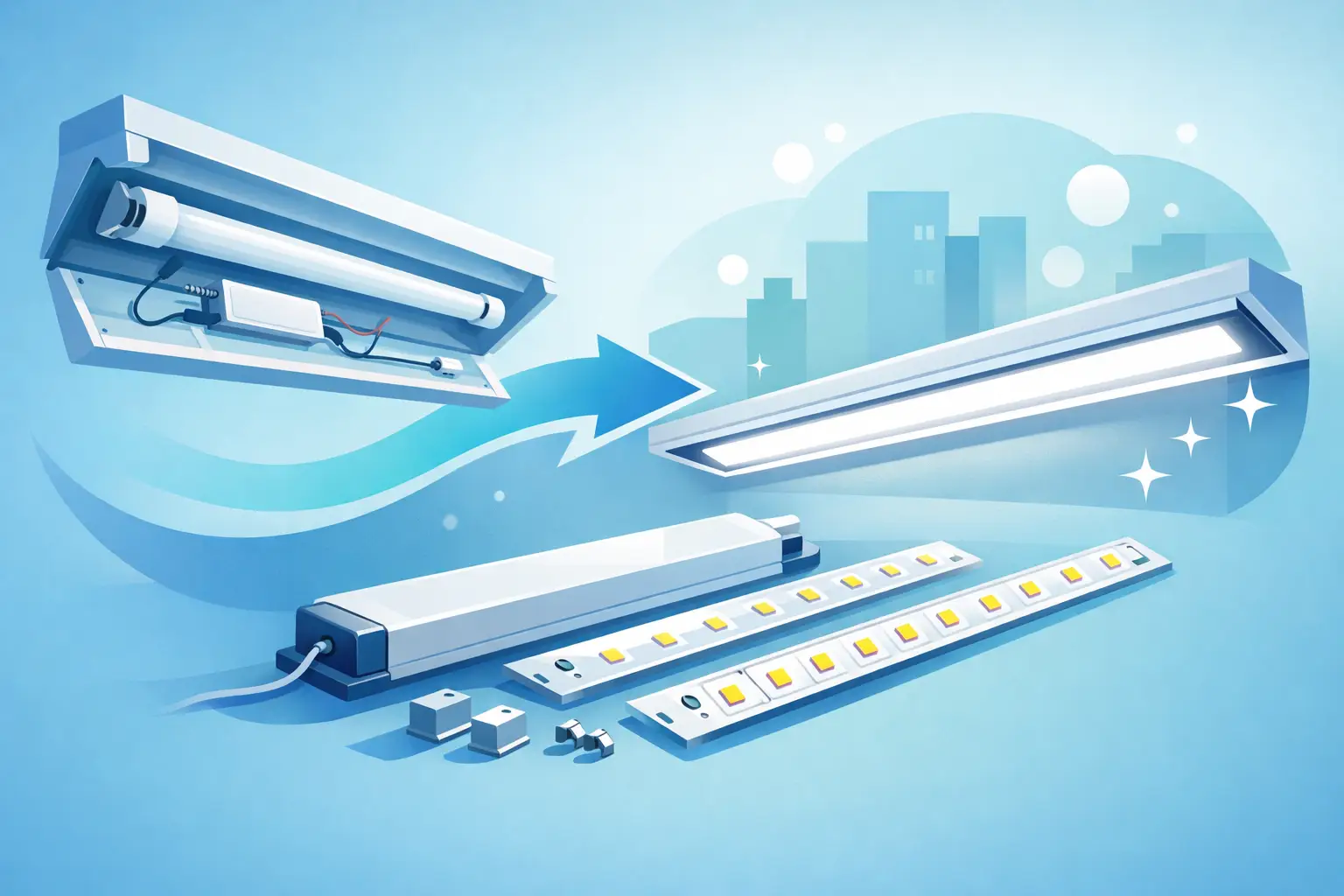
A lighting upgrade usually looks straightforward on paper until labor hits the budget. That is where led strip retrofit kits change the economics. Instead of replacing entire fixtures, they let commercial and industrial facilities upgrade the light engine inside existing housings, which cuts material waste, reduces disruption, and shortens install time in a way owners, contractors, and maintenance teams can actually feel.
For buyers responsible for schools, warehouses, offices, healthcare spaces, and multi-site portfolios, the appeal is not just lower wattage. It is the combination of speed, consistency, and long-term savings. When a retrofit kit is engineered well, you get better light quality, fewer installation variables, stronger rebate potential, and a faster return than many full fixture replacements can deliver.
Why led strip retrofit kits make sense
The strongest case for led strip retrofit kits is operational, not theoretical. Many fluorescent troffers and strip fixtures still have serviceable housings, but the lamps, ballasts, and maintenance burden no longer make financial sense. Replacing the entire fixture adds cost, creates more waste, and often introduces avoidable labor.
A retrofit kit keeps the useful parts of the existing fixture and upgrades the performance-critical components. That matters in occupied buildings where ceiling disruption, access limitations, and schedule pressure can turn a simple lighting project into a costly one. In industrial settings, every extra minute on a lift affects labor. In commercial interiors, every room taken offline affects operations.
There is also a margin issue for contractors and distributors. Products that install quickly and predictably reduce callbacks, simplify crew planning, and protect project profitability. That is often the difference between a retrofit that looks good in a proposal and one that performs well in the field.
What separates a strong retrofit kit from a commodity option
Not all retrofit kits solve the same problems. Some simply swap in LED components and leave the installer to work around poor fit, weak mounting methods, or inconsistent driver performance. Others are built around real installation conditions.
The biggest difference is usually in the mounting and wiring approach. A kit that can be installed without extensive drilling, fabrication, or fixture modification saves more than time. It lowers the skill barrier, reduces the chance of errors, and makes output more consistent across large projects. That is especially valuable for portfolio retrofits where dozens or hundreds of fixtures need to be upgraded on schedule.
Fixture efficacy matters too. High efficacy does more than reduce energy bills. It increases rebate value in many programs and improves payback math. When fixture performance moves into top-tier efficiency levels, the financial case becomes much easier to approve.
Long life is another area where cheap products tend to fall short. Commercial buyers are not just purchasing LEDs. They are purchasing fewer relamping cycles, fewer service calls, and less disruption over time. A retrofit kit should be evaluated as an operating asset, not a line item.
Installation speed is a business issue
Lighting buyers often focus first on wattage and price. Those matter, but labor cost regularly decides the real project outcome. A kit that takes 15 or 20 minutes to install can erase the savings gained from a lower purchase price. A kit that installs in a few minutes changes the conversation.
This is why contractor-aware product design matters. Tool-free installation methods, magnetic mounting, and simplified wiring reduce labor dependency and help facilities move faster with existing maintenance personnel rather than waiting on outside electrical labor for every space. In the right application, that can sharply reduce total installed cost.
It also reduces intrusion. In schools, hospitals, manufacturing floors, and active offices, long fixture changeouts create scheduling problems. Faster retrofits mean less disruption to staff, patients, students, tenants, or production teams. That benefit rarely shows up fully in a product spec sheet, but it is very real once a project starts.
Where led strip retrofit kits fit best
Led strip retrofit kits are a strong fit in facilities with large counts of fluorescent strip and troffer-style fixtures where the housing remains structurally sound. Warehouses, utility areas, corridors, storage rooms, parking-related interior spaces, back-of-house commercial areas, and institutional buildings are all common candidates.
They are especially effective when a facility wants to improve performance without taking on a full fixture replacement scope. If the goal is to cut energy use, reduce maintenance, and improve light levels while controlling labor, a retrofit kit is often the cleaner path.
That said, it depends on fixture condition and project goals. If housings are damaged, aesthetics are a major concern, or code-driven changes require a new luminaire, full replacement may still be the better move. A good lighting plan does not force one answer onto every fixture type. It matches the product to the building condition, labor environment, and financial target.
Efficiency, rebates, and ROI are connected
Commercial retrofit projects are approved on numbers. The three that matter most are installed cost, utility savings, and payback period. High-performance retrofit kits improve all three when they are paired with fast installation.
Higher efficacy means lower energy consumption for the same or better delivered light. In many rebate structures, that can increase incentive levels and reduce net project cost. When install time is also compressed, the savings stack quickly. This is why the best retrofit products often outperform cheaper alternatives over the life of the project.
For facility managers, that translates into easier capital justification. For contractors, it creates a more competitive proposal without squeezing labor margins. For ownership groups, it means a project that starts producing savings sooner and continues doing so for years with less maintenance exposure.
Optilumen built its retrofit platform around this exact reality – engineer the kit for faster installation, higher fixture efficacy, and long service life so the financial outcome works in the field, not just in a catalog.
Questions buyers should ask before specifying a kit
A retrofit kit should be judged by more than lamp replacement logic. Start with installation method. Does it require tools, drilling, or complex rework inside the fixture? Then look at fixture efficacy, not just raw LED board output. The housing, driver, and optical system all affect actual delivered performance.
Next, review how the product supports project execution. Is the design consistent across fixture families? Can a maintenance team handle installation, or does every fixture require licensed electrical labor? Is the product backed by a manufacturer that understands contractor constraints and can support large commercial jobs without guesswork?
Finally, think beyond day-one savings. A lower-cost kit may still be the more expensive option if it creates slower installs, weaker rebates, uneven light quality, or earlier failures. The right question is not What does the kit cost? It is What will this fixture cost us over the next 10 to 20 years?
The practical trade-offs to keep in view
Retrofit kits are not automatically the best answer in every building. If an owner wants a complete visual refresh, integrated controls package, or architectural change, a new fixture may align better with the project. Some older housings may also vary enough that standardization becomes difficult.
But in many commercial and industrial environments, the priority is performance and efficiency without unnecessary complexity. That is where retrofit kits win. They preserve what still has value, replace what no longer does, and improve project economics from both the labor side and the energy side.
The key is choosing a product designed around actual field use. The more a manufacturer understands installation realities, rebate thresholds, maintenance demands, and lifecycle cost, the more likely the retrofit will deliver what the proposal promised.
A good lighting upgrade should not create extra work to prove its value. The best led strip retrofit kits make the decision easier because the savings show up in installation time, utility bills, and day-to-day operations almost immediately. When a product does that consistently, it stops being a component choice and becomes a smarter way to run a facility.